

TRANSFORMATIVE SOLACE
Lao She Theatre, Beijing | Dec 15–16, 2025
Director - Zixin He
Co-director - Qiuying Ma
Producer - Ruitong Liu
Visual Director - Caoshi Zhou
Digital Media Designer - ElectroJam
TRANSFORMATIVE SOLACE
Lao She Theatre, Beijing | Dec 15–16, 2025
Director - Zixin He
Co-director - Qiuying Ma
Producer - Ruitong Liu
Visual Director - Caoshi Zhou
Digital Media Designer - ElectroJam



Renderings ↓


Human beings possess something uniquely our own: an emotional temperature that cannot be quantified or encoded. Artificial intelligence, by contrast, is “unfeeling”—its rationality is absolute, its calculations free from bias. The very complexity of human existence lies in our being “sentient”: we are born with the capacity to feel, and are therefore driven, constrained, and troubled by emotion. This tension between human beings and AI forms the fundamental dramatic conflict at the heart of the play.
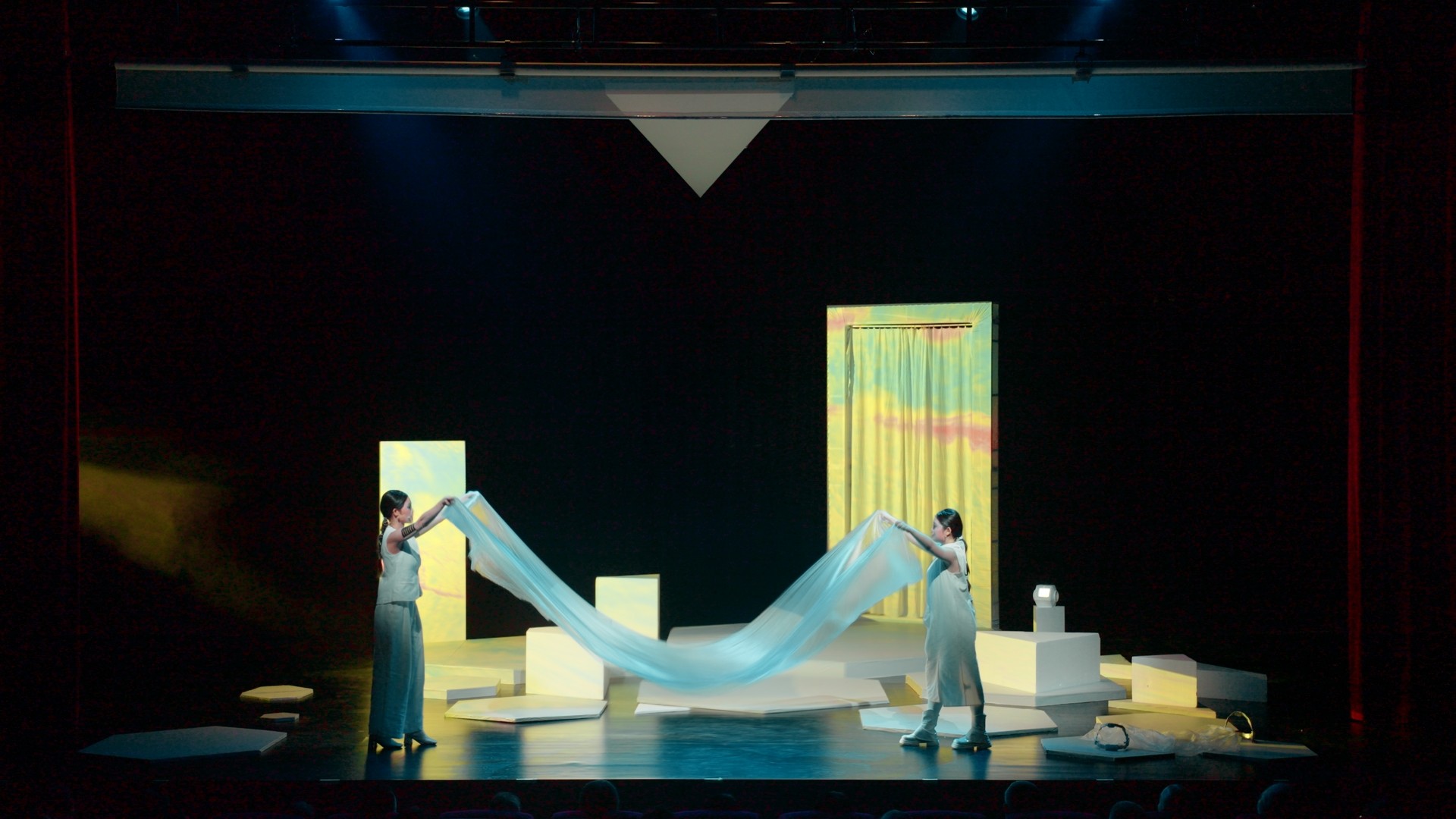
For this reason, I chose an extremely restrained palette of low-saturation gray and white for the overall stage environment. By stripping away explicit references to “time,” the design also dissolves any fixed attachment to “everyday reality.” I did not want the space to be categorized entirely as either “past” or “future,” but rather to exist in a suspended state—a medium capable of containing uncertainty and the lingering echoes of emotion.
To further express the fluidity of emotion, I introduced a vertically descending scrim in the downstage area. At a crucial moment of emotional eruption midway through the performance, the scrim slowly lowers, eventually covering the audience’s entire field of vision. Through it, only the blurred silhouettes of the actors remain visible. At this point, a camera onstage captures the actors’ faces in real time and projects them onto the scrim: enlarged faces, subtle tremors of expression, and the turbulence of emotion become the most immediate visual impact.
In conventional theatrical practice, emotional expression often depends on “distance”—the tension of the body, the rhythm of movement, and the spatial relationship between performer and audience. Live video, however, allows the audience to witness the instant before a tear falls, the faintest shift at the corner of a mouth, or the moment an emotion begins to collapse. The image does not replace theatre; rather, it helps us “see” emotion more closely, responding to theatrical performance through the language of cinema. The “coldness” and “emptiness” of the scenic environment are therefore intentional: they create a wider field in which “warmth” and “emotion” can emerge with greater intensity.


Human beings possess something uniquely our own: an emotional temperature that cannot be quantified or encoded. Artificial intelligence, by contrast, is “unfeeling”—its rationality is absolute, its calculations free from bias. The very complexity of human existence lies in our being “sentient”: we are born with the capacity to feel, and are therefore driven, constrained, and troubled by emotion. This tension between human beings and AI forms the fundamental dramatic conflict at the heart of the play.
For this reason, I chose an extremely restrained palette of low-saturation gray and white for the overall stage environment. By stripping away explicit references to “time,” the design also dissolves any fixed attachment to “everyday reality.” I did not want the space to be categorized entirely as either “past” or “future,” but rather to exist in a suspended state—a medium capable of containing uncertainty and the lingering echoes of emotion.


To further express the fluidity of emotion, I introduced a vertically descending scrim in the downstage area. At a crucial moment of emotional eruption midway through the performance, the scrim slowly lowers, eventually covering the audience’s entire field of vision. Through it, only the blurred silhouettes of the actors remain visible. At this point, a camera onstage captures the actors’ faces in real time and projects them onto the scrim: enlarged faces, subtle tremors of expression, and the turbulence of emotion become the most immediate visual impact.
Renderings ↓
In conventional theatrical practice, emotional expression often depends on “distance”—the tension of the body, the rhythm of movement, and the spatial relationship between performer and audience. Live video, however, allows the audience to witness the instant before a tear falls, the faintest shift at the corner of a mouth, or the moment an emotion begins to collapse. The image does not replace theatre; rather, it helps us “see” emotion more closely, responding to theatrical performance through the language of cinema. The “coldness” and “emptiness” of the scenic environment are therefore intentional: they create a wider field in which “warmth” and “emotion” can emerge with greater intensity.