


TRANSFORMATIVE SOLACE
Peking University Hall, Beijing | March. 23
Director - Zixin He
Producer - Ruitong Liu
Visual Director - Caoshi Zhou
Digital Media Designer - ElectroJam
I believe the core of this play lies in emotion—a uniquely human, unquantifiable, and unprogrammable emotional temperature. Artificial intelligence is devoid of feeling; its rationality is absolute, unbiased, and precise. In contrast, human beings are complex precisely because we possess emotion. We are born sentient, conscious, and inevitably tethered by emotions. This emotional tension is the fundamental source of drama between the human characters and the AI.


Thus, I chose a deliberately restrained visual palette for the stage—low-saturation shades of gray and white—removing any clear indicators of time, and dissolving the conventional emphasis on reproducing “real life.” I didn’t want the space to be clearly categorized as either “past” or “future,” but rather suspended in an in-between state—a medium capable of holding uncertainty and emotional echoes.


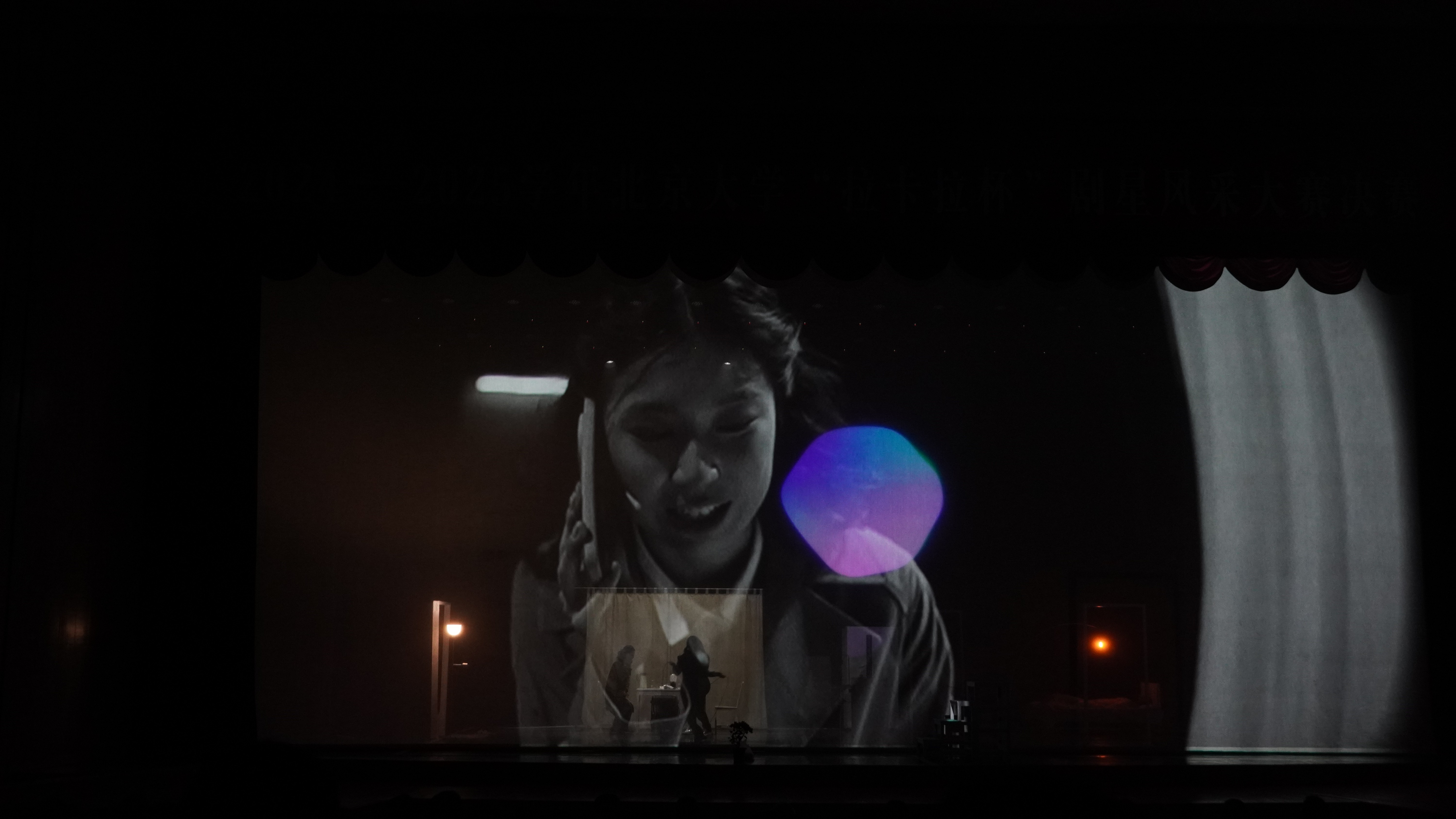


In traditional theatrical practice, emotion is conveyed through “distance”—through stylized movement and staging. But today, we can let the audience witness that exact moment when a tear almost falls, or when a smile collapses. Video does not replace theatre; it helps us see emotion. It borrows the language of cinema to nourish the stage. The spatial “coldness” and “emptiness” of the set exist to allow warmth and feeling to take root and flourish.
This space is a threshold where the coldness of technology and the warmth of humanity coexist—a place where reality has receded, but memory still lingers: a terrain of lingering warmth.
Playback Control Interface ↓
The stage is not merely a representation of life—it is a structured resonance distilled from it. In this vast, restrained space, we have left ample room for breath and silence, to be filled by the actors’ bodies, emotions, and technological devices.
To further express the fluidity of emotion, I incorporated a controllable gauze curtain at the front of the stage. At the beginning of the performance, it is only partially lowered to accommodate interactions between the AI voice sphere and the actor—a barrier, but also an interface. As the performance reaches its emotionally intense moments, the curtain gradually descends, eventually covering the entire view of the audience. Through this veil, the human form appears only as a faint, flickering silhouette. At this point, the onstage cameraman captures the actor’s facial expressions in real time and projects them onto the gauze—enlarged human faces, trembling micro-expressions, and rising emotion—striking the audience directly.
On the stage floor, I used a cold, light-reflective gray vinyl to trace the layout of a “room” in linear outlines, linking it with the contours of furniture and door frames. These lines are not physical “boundaries” in the realistic sense, but lingering structures of memory—neural pathways of emotion. They do not form solid walls but evoke psychological boundaries.
TRANSFORMATIVE SOLACE
Peking University Hall, Beijing | March 23, 2025
Director - Zixin He
Producer - Ruitong Liu
Visual Director - Caoshi Zhou
Digital Media Designer - ElectroJam
Playback Control Interface ↓
I believe the core of this play lies in emotion—a uniquely human, unquantifiable, and unprogrammable emotional temperature. Artificial intelligence is devoid of feeling; its rationality is absolute, unbiased, and precise. In contrast, human beings are complex precisely because we possess emotion. We are born sentient, conscious, and inevitably tethered by emotions. This emotional tension is the fundamental source of drama between the human characters and the AI.
Thus, I chose a deliberately restrained visual palette for the stage—low-saturation shades of gray and white—removing any clear indicators of time, and dissolving the conventional emphasis on reproducing “real life.” I didn’t want the space to be clearly categorized as either “past” or “future,” but rather suspended in an in-between state—a medium capable of holding uncertainty and emotional echoes.
On the stage floor, I used a cold, light-reflective gray vinyl to trace the layout of a “room” in linear outlines, linking it with the contours of furniture and door frames. These lines are not physical “boundaries” in the realistic sense, but lingering structures of memory—neural pathways of emotion. They do not form solid walls but evoke psychological boundaries.
The stage is not merely a representation of life—it is a structured resonance distilled from it. In this vast, restrained space, we have left ample room for breath and silence, to be filled by the actors’ bodies, emotions, and technological devices.
To further express the fluidity of emotion, I incorporated a controllable gauze curtain at the front of the stage. At the beginning of the performance, it is only partially lowered to accommodate interactions between the AI voice sphere and the actor—a barrier, but also an interface. As the performance reaches its emotionally intense moments, the curtain gradually descends, eventually covering the entire view of the audience. Through this veil, the human form appears only as a faint, flickering silhouette. At this point, the onstage cameraman captures the actor’s facial expressions in real time and projects them onto the gauze—enlarged human faces, trembling micro-expressions, and rising emotion—striking the audience directly.
In traditional theatrical practice, emotion is conveyed through “distance”—through stylized movement and staging. But today, we can let the audience witness that exact moment when a tear almost falls, or when a smile collapses. Video does not replace theatre; it helps us see emotion. It borrows the language of cinema to nourish the stage. The spatial “coldness” and “emptiness” of the set exist to allow warmth and feeling to take root and flourish.
This space is a threshold where the coldness of technology and the warmth of humanity coexist—a place where reality has receded, but memory still lingers: a terrain of lingering warmth.